ROB SCHMITZ, HOST:
Jesse Welles sings the news.
(SOUNDBITE OF SONG, “WAR ISN’T MURDER”)
JESSE WELLES: (Singing) War isn’t murder. Good men don’t die. Children don’t starve and all women survive.
SCHMITZ: His song “War Isn’t Murder” has millions of views across social media.
(SOUNDBITE OF SONG, “WAR ISN’T MURDER”)
WELLES: (Singing) Let’s talk about dead people. I mean a dead people.
SCHMITZ: The 33-year-old does not mince words.
WELLES: I really think people are made to create stuff. Some people build tables, and some people make pottery. Some people make spreadsheets. I make tunes.
SCHMITZ: You make a lot of them.
WELLES: Yeah. I’m sorry.
SCHMITZ: Sorry or not, Welles’ songs are gaining traction. He’s been called the TikTok Troubadour, modern-day Bob Dylan. He’s even friends with Joan Baez. He says he’ll never be a giant like those folk legends, but he says they have one thing in common, limitations on time.
WELLES: Players had to shorten their tunes up for them to fit on 45s. For me, it was like, I’m going to squeeze as much of these thoughts as I can down into 90 seconds, which was the length of a Instagram reel.
SCHMITZ: Welles films himself playing freshly written songs in a forest near his home in Arkansas, in a clearing made for power lines.
WELLES: It’s a quiet place, close enough to the road that I don’t have to walk too far, but far enough from the road that I can’t hear the cars go by. I like it out there.
SCHMITZ: And with the news coming at us every which way these days, I ask Welles how he decides on what to sing about.
WELLES: I guess when I reckon I have an opinion. It feels like been constant chaos, constant distraction being used as a tool. It’s being implemented to stupefy Americans. Chaos, total and constant psychological war on the ability for anybody to concentrate on one thing long enough to fully take in the ridiculousness and the cruelty of it all. All pretense has been thrown out. When they do something, it’s for obvious reasons now. They don’t even bother hiding. That’s where, like, “Masks Off” comes from. The masks are off.
(SOUNDBITE OF SONG, “MASKS OFF”)
WELLES: (Singing) All the masks are off, and they don’t even try. They know that you know that they know, and they don’t even mind it. All the masks are off, and they’re getting lazy. They think you’re so d*** stupid. They think you’re so d*** crazy.
SCHMITZ: I can tell that you feel strongly about this. It makes you angry, right? And so is that the process, where you just – you see something, it bothers you and say, hey, I got to write this down?
WELLES: For some things, yes. Other things, I love them so much that I can’t shut up about them. Oftentimes, those are the nature tunes and stuff like that. But with topical stuff, it’s usually – I don’t know. A question has kind of been on the forefront of my mind lately is, are we our brother’s keeper? Am I my brother’s – is it my gig? If I see a scam going down, if I see some kind of injustice, wouldn’t it be up to me to almost warn those about it, or to bring the quiet part out into the open so that we can all kind of discuss this and be informed together? That’s how I feel about those things.
SCHMITZ: Jesse, are you religious?
WELLES: No. I’m pretty convinced that there are secrets. There are things that I can’t see, but I’m just as convinced that they’re right in front of me and that if I just sit still and listen, what’s hidden will be revealed.
SCHMITZ: I mean, you kind of mentioned in your last answer the things that maybe you’re angry about but also the things that you love about life…
WELLES: Yeah.
SCHMITZ: …Right? And I think you’re referring to this – a bunch of songs that you did. I think it was called “All Creatures Great And Small.” Is that right?
WELLES: Yeah.
SCHMITZ: Yeah. And that album is just – what I love about that album is that every song title is just one word, “Turtles,” “Bugs.” It just goes down the line. (Laughter).
WELLES: Yeah.
SCHMITZ: And actually, the song, “Turtles,” was one of my favorites.
(SOUNDBITE OF SONG, “TURTLES”)
WELLES: (Singing) Turtles. (Vocalizing).
SCHMITZ: It’s about the beauty and wonder and awe of what a turtle can do.
WELLES: “Turtles” just comes out of my bona fide love for turtles.
(SOUNDBITE OF SONG, “TURTLES”)
WELLES: (Singing) They got places to go and things to see, and they don’t need you, and they don’t need me tellin them…
I’ve always been fascinated with them, and I’ve always seen them everywhere I go, here in Arkansas and really anywhere. I just always have my eyes open for the turtles. I just – I love all critters.
SCHMITZ: Let’s talk about another song of yours. It’s called “Red.”
(SOUNDBITE OF SONG, “RED”)
WELLES: (Singing) I got a red house and a red car, runs on big red batteries. Used to be blue 15 minutes ago but then turned red just for me.
SCHMITZ: You know, this is clearly about the Trump administration, about President Trump. You talk about his red hat, red tie, big pen. The part of the song that I found most interesting is where you talk about when the war comes.
(SOUNDBITE OF SONG, “RED”)
WELLES: (Singing) When the war gets here, we’re all gonna hold hands. All the Baptists and the Catholics, all the Marxists and the fascists.
SCHMITZ: And I felt like you’re saying here that when people get to the point where they’re fighting for their beliefs instead of, you know, those who are manipulating those beliefs, that there’ll be some sort of unity in that. Or am I way off base there?
WELLES: I don’t think that you’re off base, but really what I reckon is that a lot of the fighting amongst us, a lot of our arguments won’t seem like such a big deal when a real war hits the beaches. Or maybe it’s that the war has been waged against us by getting us to fight within ourselves and amongst ourselves. And we were just pawns in it all along.
(SOUNDBITE OF SONG, “RED”)
WELLES: (Singing) I got some red pills and a bottle. I got black and blue ones, too. All the pills are all the same. The illusion is you choose.
SCHMITZ: You know, you’re probably one of the only singers that I listen to that sings about the U.S. healthcare system. You have many songs about this. You’ve got this one song called “United Healthcare” (ph). It encapsulates so many people’s frustrations with insurance companies.
(SOUNDBITE OF SONG, “UNITED HEALTH”)
WELLES: (Singing) There’s an office in a building and a person in a chair. And you paid for it all, though you may be unaware. You paid for the paper. You paid for the phone. You paid for everything they need to deny you what you’re owed. There ain’t no you.
SCHMITZ: There’s one line in it that I wanted to ask you about. When you sing, CEOs come and go, and one just went. And I’m assuming here you’re talking about United Healthcare CEO Brian Thompson, who was murdered in New York City. You know, I heard that line, and I paused a little. And I’m wondering, when you wrote this song, did you struggle over that line?
WELLES: When they murdered him, I put up on Threads that no man’s death should be celebrated and was promptly informed just how everyone else felt about that. I still believe that no man’s death should be celebrated. I think it does the dead no good, and it does the living even worse. But there are times where the ingredients you got bake the cake that you get. And it’s incredibly unfortunate that somebody felt – that so many feel – that they are in such a hopeless position that somebody else’s death would fix it. That’s a sad state of affairs.
SCHMITZ: I want to talk about one more of your songs. In your song, “The Poor,” you sing about poverty and almost about how often poor people are blamed for being poor.
(SOUNDBITE OF SONG, “THE POOR”)
WELLES: (Singing) If you worked a little harder, then you’d have a lot more. So the blame and the shame’s on you for being so d*** poor. It ain’t the fight…
SCHMITZ: Tell me about the process of writing this song. What went into that?
WELLES: You grow up hearing these things tossed out amongst the people in your town, which is comical looking back because we were all living in some strata of poverty. But still, one would tell the other, if you worked a little harder, you wouldn’t be so poor. It’s your own fault you’re poor. It’s your own fault you’re fat. It’s your own fault you’re this or that. It always – it was always the person, the individual’s fault. And I just try to take those little meaningless backwards aphorisms that I grew up with and turn them on their head.
SCHMITZ: You know, there’s one line in that song where you say – you’re talking about, I was selling chocolate bars. I had a disorder. I was cutting up a frog, got lost in the fog, learning how to play a recorder. I mean, this brings up so many memories of school for most Americans, I think.
(SOUNDBITE OF SONG, “THE POOR”)
WELLES: (Singing) I was selling chocolate bars. I had a disorder. I was cuttin’ up a frog. Got lost in the fog learning how to play a recorder. If you only worked a little harder.
It’s an autobiographical tune. What I thought stood out was that they had us selling chocolate bars as fundraisers for band instruments. This school – they couldn’t afford books, couldn’t afford music instruments. You can’t even afford school lunches, but the football field would be put in – a turf field would be put in. And the whole football team would have new helmets and shoulder pads, but you couldn’t afford a tuba for the d*** band, so much so that they’d have the kids go out and work for it. And I just thought that was backwards.
(SOUNDBITE OF SONG, “THE POOR”)
WELLES: (Singing) If you worked a little harder, ah-ha. If you worked a little harder, ah-ha.
SCHMITZ: How long are you going to be doing this, Jesse, you know, this formula of filming yourself out in the forest?
WELLES: I don’t know. Maybe I’ll stop today. Maybe I’ll do it until I’m old and gray. I don’t know.
SCHMITZ: I feel like you just had the first lines of a song there.
WELLES: Maybe. I guess you’ll have to send me the recording.
SCHMITZ: (Laughter) Well, we will do that.
WELLES: (Laughter).
SCHMITZ: That is singer-songwriter Jesse Welles. Jesse, it is a sincere pleasure to speak with you.
WELLES: Thanks for talking with me.
(SOUNDBITE OF SONG, “SPIRIT QUEST”)
WELLES: (Singing) Ain’t it funny how the things you thought you needed were just prisons of the mind?
https://www.npr.org/2026/04/26/nx-s1-5795566/musician-jessie-welles-sings-about-the-news-to-great-fanfare
Category: News

NPR: Jesse Welles sings about the news, to great fanfare

Fayettville Matters – MerryWilder
Fayetteville: Why It Matters
Well, there’s another tour finished, another chapter ended and in the books. You could say that about every tour that finishes on a high note, I suppose, but this one felt different. This one didn’t feel like “just another tour.” There was something about this one….
Of course, there’s something about a Jesse Welles show, too, something (maybe even several somethings) that makes Jesse’s shows different from those of any other performer – past or present. Yeah, I said it. Jesse himself is different from any other performer working today OR any performer we’ve ever seen before. Yep, I said that, too. But we’ll get to that in a bit.
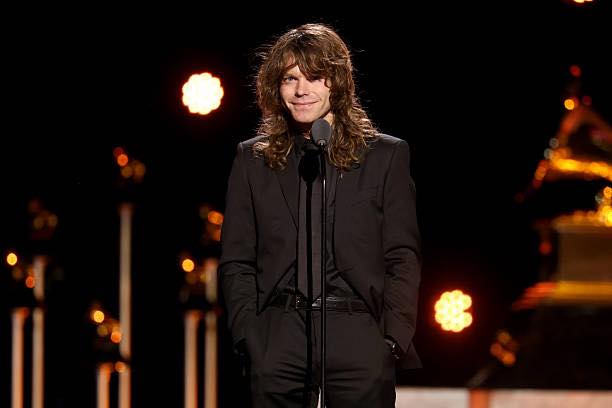
Back to this tour that just finished, this sold-out international tour that just finished, in Jesse’s hometown. This tour that began in Australia – although the Oz dates did have to be moved up, so Jesse could attend the Grammys. And it wasn’t because, as many thought, he wanted to be on hand in case he won any of the four Grammys for which he was nominated (Best Folk Album for “Under the Powerlines,” Best Americana Album for “Middle,” Best Americana Roots Song for “Middle,” and Best Americana Performance for “Horses”). No, it was because they asked him to present. As it turned out, Jesse did not win a Grammy this year, but he was onstage presenting for more than 10 minutes. Just Jesse, all alone up there in his dapper all-black suit, seeming totally at ease, presenting for eight different awards, and reading acceptance speeches for three of them (sometimes lengthy acceptance speeches – lookin at you, The Cure).
But there’s Jesse up there, not even breaking a sweat…. as if jetting in from Australia and appearing onstage at the Grammys was something he’d done dozens of times. No biggie. It’s important to remember that Jesse announced the Under the Powerlines tour on August 19, 2025, before the Grammy nominations were announced. Post-Kimmel, but pre-Colbert. Pre-Joan Baez joining him onstage in San Francisco during the Middle Earth tour. Pre-Farm Aid 2025, their massive 40th anniversary celebration.
August 19, 2025. Twelve days after he dropped “Join Ice,” and a little over three weeks since his history-making appearance at the Newport Folk Festival. Although in Jesse Welles’s world, things were definitely picking up speed, still this tour announcement seemed not unlike the previous three tours he’d undertaken in this, the newest iteration of his career.
But even Jesse himself couldn’t have foreseen how quickly events were going to be moving for him in the very near future.
Jesse’s rising fame and his long-standing ability to crystallize in song form the pertinent events of the day (and to skewer the bad actors responsible for those events) combined to really push the wind up under his wings. It must’ve been a bit like riding an updraft, when the Grammy nominations were announced on November 7th, followed by their request for him to come be part of the show, and to perform in the pre-Grammy celebration of the songs of Neil Young.
And 2026 had barely gotten underway before that misguided “paramilitary operation” that, back in August, had earned itself a Jesse song (not usually a complimentary achievement) went into Minneapolis, and went into turbo-charged overdrive. Sadly, there was soon a new Jesse song, “Good vs Ice,” while his song “Join Ice” drew new listeners daily. Dreadful things were happening in America, happening quickly. More and more folks seemed to depend on Jesse to help them make sense of the awful events they were seeing. The public was assigning to him not just the burgeoning status of a rising talent in the music world, but that of cultural arbiter as well. Suddenly millions of people around the world were relying on Jesse to tell them the truth about current events, and to remind them of the moral certainty which this age all too often seems to have lost.
That’s a heavy weight for anyone’s shoulders to bear.
But it would seem that Jesse is uniquely qualified for just this very task.
Most of you reading this probably know something of Jesse’s history: how he saved up the money to buy his first guitar at age 12, how a kind neighbor named Harlan got him started on learning the basics, how he began home recording with the help of a classmate and said classmates’s recording software. How an undeniable affinity for music developed into his becoming a musical prodigy, and then a young man who felt compelled towards a life in music. How his initial dreams of achieving success as the front man of his own rock’n’roll band ended when Covid began. How he actually did try to stay away from music for a couple of years (other than teaching guitar to kids), but he just wasn’t able to do it.
How his dad had a heart attack in February of 2024, which led Jesse to a hospital bedside epiphany… while reading the autobiography of Woody Guthrie.
Although Jesse had been posting songs (mostly covers) to his brand new TikTok account since November of 2023, I mark this current iteration of Jesse’s career to have begun on April 18, 2024, when he began posting mostly originals to his newly scrubbed YouTube account (he left his Welles YouTube account intact, and it’s still up to this day). On April 18, 2024 he posted “War Isn’t Murder” to his YouTube account. He would post three more songs that April, nine in May, fifteen in June, fourteen in July, etc…. The new Jesse Welles Era had well and truly begun.
If you’re at all familiar with Jesse’s work, you know that he has incredible range – not only musically but lyrically as well. He’s comfortable tackling subject matter as sweet and simple as turtles, bugs, trees and vegetables, as brutal as governmental forces casually murdering people across the globe as well as citizens here in America (while shielding grapists and pita files from justice), as esoteric and ethereal as songs that explore our place as souls down here in the heavy gravity, and what it is we should really be doing with our soul-selves while we’re clomping around in these mortal bodies… He is a natural-born musician, can play anything he picks up, can play any piece of music by ear. He is an amazingly accomplished guitarist and a genius wordsmith with his lyrics, many having more layers than those famous wild onions he sings about. He is jaw-droppingly prolific, rapidly putting out tons of songs – good songs, worthy of repeated listening! And he is doing all of this today, putting out songs and albums and selling out tour after international tour, all while being an unsigned artist. I believe it is his very freedom from the shackles and demands of a recording contract (and he knows all about those) that has in no small part enabled his stunning success since 2024: he has the artistic freedom to do exactly as he pleases, with no one trying to steer him or ‘advise’ him or curtail him. He is free.
In late July of 2024, based on the growing success of his music on social media platforms, he announced his first tour of this new era, to test the waters, to see how high was the demand. The tickets became available on July 26, 2024, for the 8-date tour that autumn (Saratoga Springs NY [Farm Aid], New York City, Denver, Seattle, San Francisco, Washington DC, Boston, Chicago). They sold out almost immediately, eliciting an online “Whoa, that was fast” from the man himself. The waters were good, and the demand was high.
Two more tours followed in 2025: the Fear is the Mind Killer tour (29 dates, from February 15 to May 14, including 5 European dates added on), and then the Middle Earth tour (19 dates, from September 20 to December 15, this time including 7 added-on European dates).
And in August of ’25 he announced the Under the Powerlines tour. As the paroxysms of a world in crisis intensified, so it seems did Jesse’s creative spirit grow to meet the moment.
For instance, he dropped “Masks Off” on December 30, 2025, a song that he would soon re-work into a chugging, charging rock’n’roll anthem for his live sets. The lyrics of this song and their rap-like, nearly staccato rapid fire delivery were unlike anything Jesse had ever done before. A blistering takedown of virtually everything that’s going wrong with America right now, Jesse calls out several Arkansas politicians by name. The song is packed with many examples of his trademark wordplay and pithy intensity: “the loogie of factions that the nation has hacked/ is boiling and festering and stabbing itself in the back.” The masks are off, indeed.
He followed that up with the song “Nothing” on January 13, 2026. A melancholy meditation on the inner sickness that drives a certain type of person to try to fill that hole in their soul with money or power, never being able to have enough of either – the song opens with a 48-second wicked bluegrass intro that segues into the body of the song by way of a few seconds of Edvard Grieg. You know, the usual. Lyrics include “crazy men with bloodshot eyes/ shoot their rockets in the sky/ drunk with power high with rage/ ..new men in the same old cage.”
And then on February 19, 2026, we were treated to the song “Whirlwind,” an angry whirlwind of a song that again calls out the failing leaders by name (“I’ll have what they’re having while they’re wreaking havoc/ The Floridian Lobotomy/ Hey Marco, Susie, Dr. Oz and Pam Bondi/ No one has each other’s backs/ Like the parasitic class/ You gotta admire the fire, the passion/ They have to cover each other’s ass”). And he does not spare the failing-leader-in-chief: “It ain’t 5-dimensional chess/ It’s dementia doing its best/ Ring a ding-ding/ You got the mad king/ And he’s mean/ When he’s depressed.”
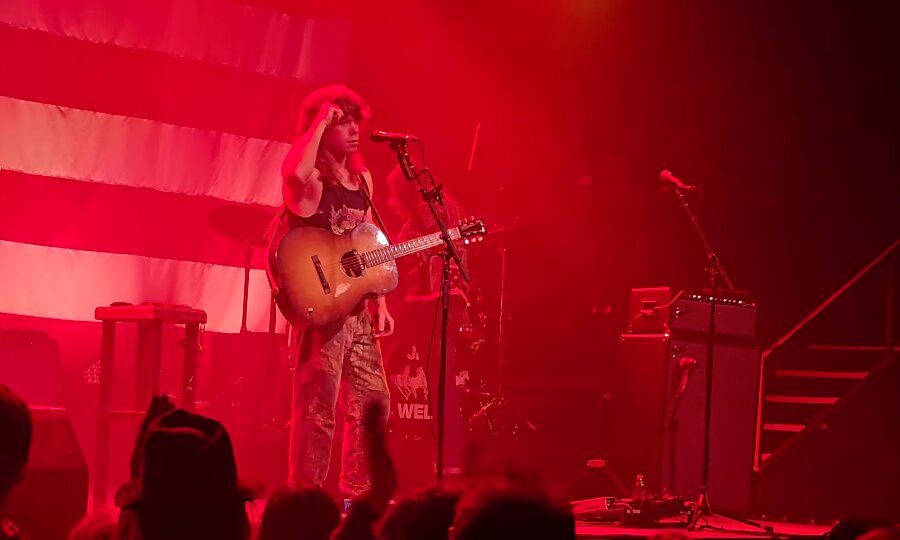
Jesse was accompanied on the Under the Powerlines tour by the same group of musicians he had with him on his Middle Earth tour in the fall of 2025 (although only Joel and Connor went to Australia with him): Adam Meisterhans on slide guitar, Bobby Steinfeld on keyboards, Joel Parks on bass guitar and Connor Streeter on drums. He may have had his same crew with him but Jesse modified the live show a bit, tightening it up from four sets into three well-paced courses: first the solo acoustic set, bringing the band onstage at the end of “The Poor” on a crashing note that lights up the house as a gigantic American flag cascades down behind them, forming the backdrop for the rest of the night; then a rocking set with the full band, including that face-melting live version of “Masks Off”; then an expanded encore set, which begins with Jesse playing onstage alone with his acoustic, but brings the band back out for “Fear Is the Mind Killer” before Jesse is again alone to close out the night.
Beginning his tour on January 19 in Melbourne Australia, he spent a jam-packed 10 days down under, performing 9 shows in 5 different cities, stopping by to visit the Wiggles, and inviting Ambrose Kenny Smith of King Gizzard and the Lizard Wizard to join him onstage at his Perth gig, on January 28. It was in Australia that he first added the Black Sabbath song “Paranoid” to his live set, sending fans stateside into spasms of delighted rock’n’roll joy. His last show in Oz was January 29, in Adelaide, then he flew halfway around the world to be in Los Angeles in time to play at the “Pre-Grammy Salute to Neil Young” on January 31, at The Troubadour. When the next day dawned, CBS Sunday Morning was airing a piece they’d prepared on him, and by the afternoon, he was presenting at the Grammys.
The tour resumed in February, including a stop at the legendary Ryman Theater in Nashville. On this night, he and the band debuted their custom, matching pinstripe suits, which he has said was meant as a gesture of respect and recognition for this storied old venue.
The show in Boston at the House of Blues on March 6 was so thoroughly stunning and uproariously magnificent that Jesse posted the professionally-shot video of the entire concert to his YouTube account nineteen days later, on March 25. The whole show is a gem, from beginning to end, an outstanding evening set in a triumphant tour: all 5 of the boys were hitting their stride on this night in Boston, firing on all cylinders on every song, but none more so than “Masks Off”. Watching this video is like watching history in the making, history being made in real time, right before your eyes – watching a legend being born.
The UTPL tour included 2 consecutive nights in Minneapolis. With the events that had transpired in that city just a few weeks prior, expectations were high for these appearances, and Jesse did not disappoint. On March 12th, the first Minneapolis show, Jesse debuted a slight word change in the song “God, Abraham and Xanax”: from “Lord, is P-Diddy in trouble?” to “One, two, three, four, we don’t want your fuckin war.” Just a slight change. The audience erupted with berserker ecstasy.
Jesse, after all, finds new and creative ways to say what we’re all thinking. It’s one of his specialties.
At the Berkeley show on March 21st, Jesse again welcomed a familiar special guest: Joan Baez. She came onstage (in a Jesse Welles t-shirt, no less) to join him in singing the song “No Kings”, which they recorded after their first performance together of the song at the November 4th show at the Fillmore in San Francisco. He was swinging back through California, and his pal Joan came out to share the stage for another special moment.
Every date brought him closer and closer to home, to the Fayetteville show which was set as the final show of the tour. After Berkeley there was San Diego, then Phoenix, then two nights in Texas, Austin and Dallas. And then… Fayetteville.
It should be apparent by now that Jesse’s star was rising like never before. He was gathering steam, broadening his influence, the increased visibility causing him to pick up new fans everywhere along the way. For someone who had been pursuing a musical dream for more than a decade, it must have been exciting, fulfilling – and ironic.
No one was more aware than the hometown crowd in Fayetteville of just how long Jesse had been working towards that night at the end of March. They had seen him through all his incarnations, all his rocking and rolling, all his hair lengths, all his crazy drive, energy and output. They’d seen him playing local coffee shops at the age of 18, seen him playing open mics here and there, seen him busking on the sidewalks and in front of stores. They’d seen him playing small clubs with his first band, and small clubs with his second band. Various classmates had bought CDs he’d burned himself, of him playing covers and original songs. Teachers remembered him fondly, coming to class with his guitar slung over his shoulder, taking part in poetry slams, winning contests that bought him studio time to pursue his calling with his bands. Family members and old bandmates, of course, had always had a front row seat to the Jesse show, and everyone, everyone very much wanted to see him succeed – no matter how long it took.
So when he joked from the stage that night that he had played a lot of shows at that venue (“for tens of you”), he wasn’t kidding. But Jesse hadn’t played a show in his hometown since 2023. His hometown crew had just had to watch as their guy went out into the world again, alone this time (at least at first), and started up the latest iteration of his already-long career. This was the first time he’d brought the show back home to them since he’d started posting those YouTube videos, back in April of 2024. They’d only been watching from home, watching on their phones as their guy started to blow up… and up… and up……
So the show in Fayetteville wasn’t just another show. The Under the Powerlines tour wasn’t just another tour. The return to his hometown was a victorious and long-awaited validation, for himself and for everyone else who was paying attention, that yes, Jesse is in fact the real deal and yes, he is where he should be, doing exactly what he should be doing. All along, all through those many years, he was always doing just exactly what he should have been doing. If he is still wondering if he’s really real, if he’s still having trouble feeling self-assured, I sincerely hope that the evening of March 28th at the Ozark Music Hall in Fayetteville finally put all of that doubt behind him, for good.
Jesse’s is a talent like no other. No other musical artist of the modern age, or any age, has the incredible scope, range or expertise that he does (from rock to folk to blues to country to jazz to electronica, or some totally original mash-up thereof, of his own creation), or the ability to write lyrics that are simply poetry, sometimes cleverly folded in on themselves with multiple meanings, sometimes abrupt and forthright, and almost always with a touch of humor. Jesse’s skill as a musician also knows no bounds; although still a young man, he has been perfecting his musical art for more than 20 years, literally since childhood. When he’s at his best, the music just flows through him almost as if he’s not even there – he nearly becomes the music itself, music standing up there on stage, in shoes. The shows can feel more like revival meetings than music shows; just being in the presence of this genuine artist, this authentic talent, this light blazing away like no other has a way of blissing people out, and bringing them together in shared experiential joy. No other musical artist past or present has all of this AND also the preternatural prolificity that has always been a hallmark of Jesse’s work, the drive that sometimes has him posting multiple original songs within the span of a week. Multiple original GOOD songs.
On paper, all of this seems almost too good to be true. But true it is, as true as the words of the plain-spoken Arkansan citizens from which he hails. THEY know how incredible Jesse is, they’ve known for years. When you first encounter him and his music, it does take a while to truly take it all in, to actually realize just exactly what it is you’re dealing with, how ginormous is this talent carried by this brilliant, humble man. It takes a minute to grasp. But his homies always knew, from the time he was little… And they finally, at the end of March 2026, got to witness in person the beginning of his true flowering, that big old soul flower finally blossoming, like they always knew it would.
Jesse is no longer outside the gates of the compound crying ‘Let me in.’ He is walking in his rightful place at last, the place that was always his birthright, and by now, having honestly and fully earned the privilege of strolling about the grounds of that heady compound, taking in all the wonders and meeting all the cool folks that he knew were there to be met, all along. Jesse is finally home, in more ways than one, and where he’ll go from here…. well, that’s gonna be a sight to see. Hang on tight, because you don’t want to miss even a minute of it.
https://www.reddit.com/r/JesseWelles/comments/1sh6zxk/fayetteville_why_it_matters/
https://merrywilder.com/2026/04/09/fayetteville-why-it-matters/
Love Will Win
Jesse’s speech during Masks Off on the second night in Minneapolis, Minnesota of the Under the Powerlines Tour.
The federal government laid siege to your city.
They tried to break you and y’all broke them.
You broke them with the room you made in your heart for your neighbor.
What does that say about what fuels their machine?
Love will win!
Jesse Welles – To The People of MinneapolisPowerful words, made more powerful with the full song:

Jesse Welles turns anxiety into catharsis
REVIEW: Jesse Welles turns anxiety into catharsis at Crystal Ballroom in Portland
Who knew an extended anxiety attack could be so danceable? For 1 hour and 40 minutes, Arkansas singer-songwriter (and minted TikTok star) Jesse Welles channeled his barbed-wire-ensnared songs about injustice in politics, health care and public welfare like a fork firmly jammed into a light socket.
On his Under the Powerlines Tour, like in much of the music Welles posts online in response to whatever the horrific actualités du jour, he plays a traveling orator. So when he kicked off his show at a sold-out Crystal Ballroom with “Sometimes You Bomb Iran,” which he wrote in 2025, it felt timely. But so did most of the roughly 25 songs he performed, sometimes alone on stage and sometimes with a band that quickly ratcheted up the mood and the tempo.
The performance was broken into three parts, with Welles alone on stage for the first and most of the last, and the rock portion with the band wedged in the middle. The first act consisted of many of his viral news nuggets that cut through bureaucratic jargon using plainspoken language, sometimes tongue in cheek.
“Same old story as 2003,” he quipped during “Iran,” and in the middle of “The Great Caucasian God, “Now Portland, let me talk to you about death…”
Then he strapped on a harmonica for “Join ICE” (“If you’re lackin’ control and authority/ Come with me and hunt down minorities”) and something unusual began to take shape by the time he reached “The List” and “United Health” — the crowd, packed shoulder to shoulder, was letting out hoots and hollers while some clearly attempted to dance to these humorous songs of woe.
Did Woody Guthrie, Joni Mitchell, Bob Dylan or Joan Baez — who made an appearance with Welles last fall when the tour passed through the Fillmore in San Francisco — ever get such reactions?
Anyway, the mood turned with the appearance of the band, which joined toward the end of “The Poor,” on a kick drum hit perfectly timed to the thematic gut punch in that song — “If you worked a little harder/ Then you’d have a lot more/ So, the blame and the shame’s on you/ For being so damn poor.”
The stage lit up at this point, revealing a large United States flag — which sometimes incited earnest appreciation and at others hot-blooded shame.
This run of songs ranged the gamut from Petty-esque Southern rockers (“Domestic Error,” “Philanthropist,” a cover of CCR’s “Have You Ever Seen the Rain?”) to sludgy heavy rock like “Masks Off,” with Welles delivering a killer distorted solo on an acoustic guitar. There was also “Red,” which is equally critical of both big political parties, a cover of Black Sabbath’s “Paranoid,” a poppy and melodic “War is a God” and psychedelic “God, Abraham, & Xanax.” During the latter, which included an extended jam and a guitar freakout, Welles briefly paused to lead a protest — “One, two, three, four/ We don’t want your fuckin’ war!”
Midtempo Southern rocker “Malaise” went right into frolicking show highlight “It Don’t Come Easy” and “Horses,” the lead single from Welles’ 2025 album, Middle.
The entire band left the stage and Welles returned alone for the a six-song encore, during which the mood finally dropped a bit, but not for a lack of material that included a couple of kid-focused songs, “Bugs” (“Don’t kill a bug ‘just because!’”) and “Turtles” (“They need clean water/ And clean air/ About the same things as we need up here.”) See, these songs aren’t just stories, they are lessons, too.
There were covers of Dylan’s “Knockin’ on Heaven’s Door,” performed with opener S.G. Goodman — their voices different shades of hoarse and gravelly — and a popular rendition of John Denver’s “Take Me Home, Country Roads.” Welles included a clearly personal “See Arkansaw” and finally concluded with his poignant “War Isn’t Murder.”
While the tour moves on, Jesse Welles will return to Portland on Aug. 12, performing in Pioneer Courthouse Square with Ratboys.
Kentuckian S.G. Goodman was an intriguing opening act on Friday, opening with sad alt-country waltz “Space and Time.” But she and her backing band quickly pivoted to sleek groove-led blues-rock tune “The Way I Talk” and droning rocker “Old Time Feeling.” The latter, like most of her songs, was highlighted by organ strains that danced around the rhythm section.
Goodman introduced her latest album, 2025’s Planting by the Signs, with meditative tune “I Can See the Devil.”
“There’s not a lot of Southerners who believe in astrology, but I know you have rock shops and shit,” she said, explaining that the album is about the phases of the moon.
But the most memorable part of her set was a cover of Butthole Surfers’ mainstream hit “Pepper.” The song began at a simmer before exploding into full-throated singing and melodic Texas swing.
Roman Gokhman and Leah Flores
https://riffmagazine.com/reviews/jesse-welles-20260320/
90.7 WFUV Live Sessions – Interview
Jesse Welles has a lot to say about this American life — its sorrows, ignorance, and grace — especially over the last couple of years. He is prolific in the best way, releasing eight albums since 2024, both studio and field recordings, and at the time of his FUV Live concert at The Bitter End, Under the Powerlines (October 25-December 24).
Recent fans might have discovered Welles via his Instagram, which is at over 2.2 million followers as of the winter of 2026, or by way of TikTok (1.5 million). His lacerating dark humor, incisive (sometimes brusque) critiques, and perceptive songs hark back to forebears like Woody Guthrie, Joan Baez, Gil Scott-Heron and Mark Twain. In addition to his own Arkansas background and his role as witness to the complexities of human behavior (and tapping into characters that reflect this current climate), Welles’s muse is the news.
As a lyricist making sense of current events, his ripostes come via tracks like “War Isn’t Murder,” “Join ICE,” and “The Poor,” Welles is blunt and concise. He says exactly what needs to be said — with plenty of room for reflection.
He is a deserving recipient of the 2025 AmericanaFest Free Speech Award, handed to him by John Fogerty. Welles was also nominated for four 2026 Grammy Awards, including Best Americana Album for Middle and Best Folk Album for Under the Powerlines (April 24-September 24). He didn’t win, but it was the thought that counts. In the meantime, ahead of the Grammys, he was profiled by “CBS Sunday Morning” — and Welles will be touring with the Dave Matthews Band later this year.
In my conversation with Welles, backstage at The Bitter End before his set, we touched on various things, from his boyhood memories of Arkansas and his father, to working with Baez, one of his influences. He’s soft-spoken and perhaps deliberately cryptic when it comes to interviews, preferring his lyrics to propel his perspective. “If you stop to think, you’ll fall off the wire,” he says.
The music from this session comes courtesy of Welles’s Webster Hall shows last November: “Horses,” “Join ICE,” and a cover of the Bob Dylan-penned and Baez-invigorated “Don’t Think Twice, It’s Alright.”
https://wfuv.org/content/jesse-welles-bitter-end-2026Kara Manning: How are you, Jesse? Thank you for doing this Marquis show for WFUV. It really means a lot to us.
Jesse Welles: Oh, think nothing of it. I wouldn’t miss it. So thanks for having me.
Kara Manning: You are, over the last, since 2024, you have released at least eight albums, and an EP, and you have also changed, I know, my life in following you on Instagram about what it means to have a voice in remarking on our American life. You remind me in some ways of like greats like Gil Scott Heron or Curtis Mayfield, or Pete Seeger or Mark Twain. In a lot of ways, and I’m fascinated about your journey to this place because you have been in music for a really long time, but you had a revelation in 2023 that things were gonna be different.
Jesse Welles: Yeah. And just woke up. So I had been doing this for a long time, playing rock and roll and that sort of thing.
Kara Manning: You’re from Arkansas originally? Yeah. And your dad, who’s a mechanic, he had a heart attack.
Jesse Welles: Yeah. Yeah, he had a heart attack. So I had sat up in the hospital with him and it really didn’t look like he was gonna, he was gonna be able to swing it.
So I went ahead and drove home that evening, not too far from there, and had resolved that he was going to depart and thought how am I going to go about life moving forward? And I knew exactly how I would, and luckily he stayed with us, but I had already made up my mind. So…
Kara Manning: You had other bands?
Jesse: Yeah.
Manning: You had come off of being Wells. You came off of that whole thing sort of feeling that this wasn’t what you had envisioned. That you wanted to do. You were reading a bio on Woody Guthrie.
Jesse Welles: Yeah.
Kara Manning: At the time that your dad got sick.
Jesse Welles: That’s true.
Kara Manning: And that sort of that amazing confluence of. A kind of a, like a hitting a watershed moment for you.
Jesse Welles: Yeah.
Kara Manning: So how did that, like what did you do while you were there with your dad and figuring out what your life was and what you wanted to say?
Jesse Welles: I think it was some kind alchemical moment, some kind of spiritual alchemy, alchemy went down and something in that book and something in Got the spirit. With the great pressure of being next to potential death all mixed together and broke through whatever barrier. That had been an obstacle to me, and I went ahead and moved forward from there.
Kara Manning: It’s funny, I wanted to start off this interview congratulating you on your Grammy Awards. At the time that we’re talking in November, you have been nominated for four Grammys. But in addition, and the thing that struck me is that you at the Americana Fest, you also won the Freedom of Speech Award that was handed to you by John Fogerty.
Jesse Welles: Sure.
Kara Manning: And can’t imagine what it must have felt like to, to some how in the last two years. Become a beacon of what I think a lot of Americans are searching for in a voice that sort of echoes Woody Guthrie or Pete Seeger or Dylan or Joan Baez. How has this, how have you been processing this in your head about people are looking at you to speak to their inner feelings about what’s happening in the United States right now and the world.
Jesse Welles: Yeah, it, if you stop to think, you’ll fall off the wire. So the main thing is just been, where’s the next song? And looking for it constantly. I’m not really feeling all that great until I get to it and feeling really good while I make it. And then as soon as I put it out, I’m ready for the next one. All right. For the next one,
Kara Manning: Do you write constantly because of the fact that you’ve been so prolific between the field recordings that are on Instagram and TikTok. As well as your own studio albums like Middle and Pilgrim. Do you, are you, I can’t imagine how, when you ever stop writing, is it always something, an inner dialogue in your head about what you need and want to say?
Jesse Welles: I ask. What do folks need to hear from me and ask that, that be what I write down. Yes. It’s always writing, but I ain’t always writing a song or anything. I’m just writing, just putting thoughts together and there will be certain sentences and a journal entry where I go on therein lies the tune and then can extrapolate the tune from a couple lines or something like that.
Kara Manning: I was struck, you were on Joe Rogan a couple of months back. Yeah. And you spoke about thing I, they had one great quote in here, your, that you feel that your measure of success is how much I can be myself and be happy that way.
Jesse Welles: Yes.
Kara Manning: How, given the fact that you are now, like you’ve had bumpy roads with the music industry, now you are embraced by the music industry with the Grammy Awards and everything else that’s happening for you and selling out your tours and how are you keeping your head together, so you can continue to be happy doing what you’re doing?
Jesse Welles: By only doing what I want to do.
Kara Manning: Yeah, that’s- What are the lines that you draw?
Jesse Welles: You don’t know the, you don’t know the lines as things come, you’re making it up as you go. I’m running with an egg in a spoon, and I’m just trying not to drop it. I don’t want to, I don’t want to have no in my mouth. I like to say yes, I like to say yes and yes.
And what will we do? What next? What will that amount to, how can I do that differently than somebody I know who’s done it before? How can I do this in the way that I know is wholly mine regardless of what the opportunity is? If so. That’s that’s how I think about it.
If you draw a hard line, you’ll trip over it.
Kara Manning: I was intrigued too, that you’re in influenced by comedians. You mentioned Steven Wright.
Jesse Welles: Yeah. I love Steven Wright.
Kara Manning: Yeah. And funny, like non sequitur is very deadpan.
Jesse Welles: Yeah.
Kara Manning: When you, what other, I mean it’s, I’m thinking in terms of people like George Carlin were here at the bitter end. People like George Carlin were here.
Jesse Welles: Yeah.
Kara Manning: The legacy of you standing on that stage and knowing that, Joan Baez was on that stage. Joni Mitchell. Bob Dylan. What about the great comedians of the past that have influenced you?
Jesse Welles: I love Carlin, although I didn’t necessarily grow up on Carlin, but I found him once I saw folks were saying that, I was like, Carlin, and then I’d go back and listen to him and go, oh goodness, I am. I liked Steven Wright and I liked Mitch Hedberg and I liked one-liners essentially.
What became dad jokes over the course of my life, they were at one point just jokes and joke books, but anything that could make a kid and an old fuddy-duddy laugh to, those were the jokes that really got me.
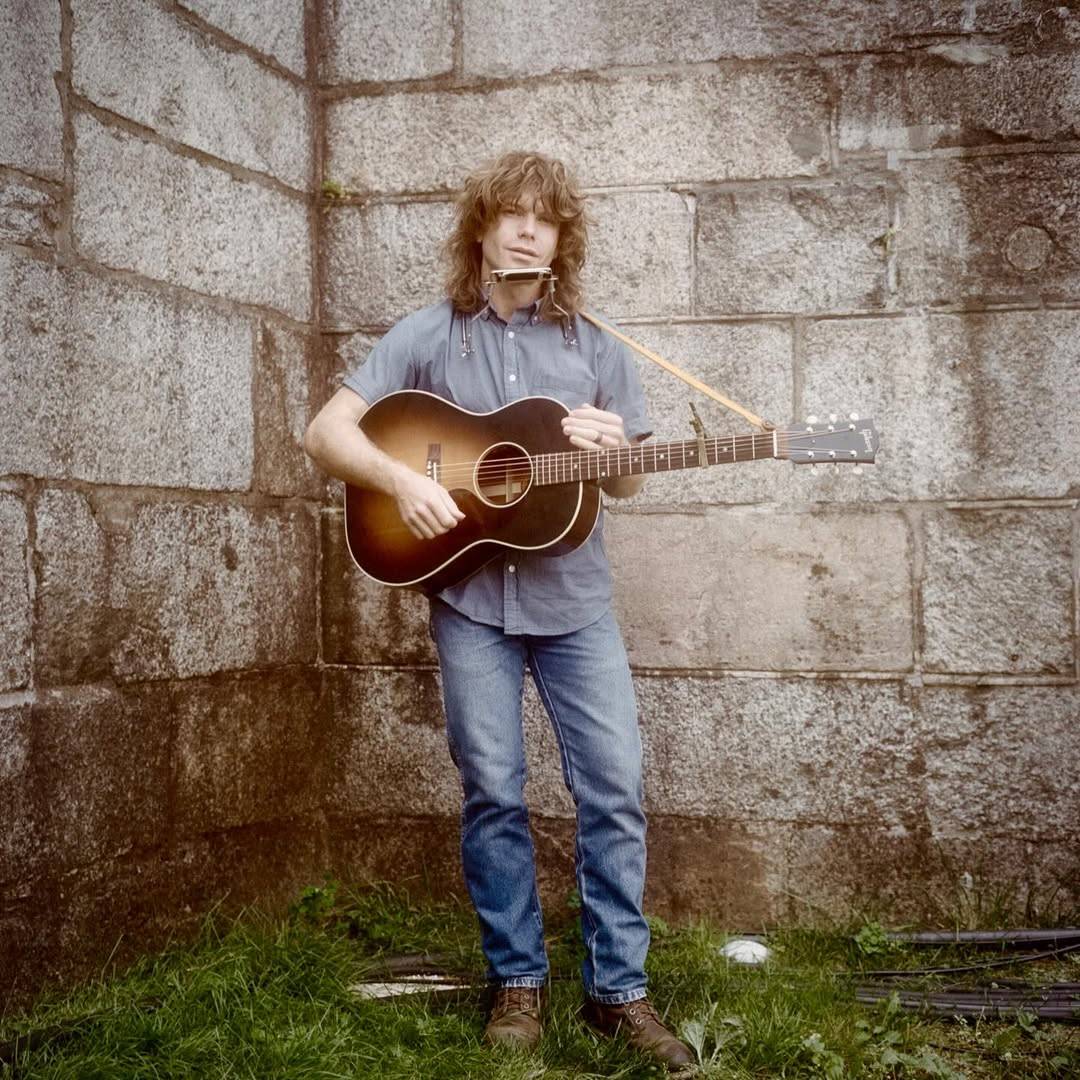
Kara Manning: Listening to you, you have for your field recordings, you use this great Ella guitar that has become synonymous with who you are. Whether you’re doing, Join ICE or Philanthropist or any of the other songs that you have done that have touched a chord with all of us.
Can you talk a bit about that Stellar guitar? Where you found it and what your dialogue is with it, and why it’s important to use that in your field Recordings.
Jesse Welles: It’s just that I’ve picked it up honest on the way back from from the hospital back there in, in ’24. So I had seen it on Marketplace, on Facebook marketplace, and I picked it up from the guy. In the Lowe’s parking lot. He met me in a town called Springdale, Arkansas, and he got it out and I said, this was somebody’s baby, ’cause it has a big crack in it, but the crack’s been repaired and who would think to repair a kid’s guitar? And it had wear on it already. And he said that he had gotten it in Pennsylvania at a Amish auction. And I thought neat, how much? And so I gave him 80 bucks for it.
And I took it and I did a tune with it, and then I just decided I would do all my tunes with it. I wanted a guitar that I could take out into the rain and that I wouldn’t have much worry about. But now I don’t like to take it out in the rain. I want to take good care of it ’cause it’s been so good to me. But it’s essentially a limb, just another limb of mine at this point. I’ve played, I spent so many hours on it in the past year,
Kara Manning: Does it come with you on tour? Do you feel protective of it?
Jesse Welles: I’ve brought it on some things when it makes sense. Yeah. But when I’m going to I don’t think as a rule, besides the rain, I don’t think it’s. Too good to be precious with really anything. Just go ahead and use it. That’s what it was made to do.
Kara Manning: Horses was one of the earliest songs that you did on TikTok.
Jesse Welles: Yeah.
Kara Manning: That is now nominated for a Grammy which is a huge deal. But I was wondering when the, what was the first song that you felt that you needed to address, whether it be an injustice or something that was happening in the news cycle that you stepped, that you began filming yourself and said, I’m gonna put this out here.
Jesse Welles: I feel like I had a few starts, not necessarily non-starters, but just starts getting up and going and getting my pace set. But once I did War Isn’t Murder, I knew as I was writing it, that for once I had really written something that was important to me, that I could sing and really mean and that kind of gave me direction.
People responded to it, people engaged with it, and that gave me just about all the energy I needed to keep going and keep making songs.
Kara Manning: It’s interesting. We’re approaching a year of the anniversary of the Assassination of Brian Thompson, of United Healthcare. Which was in December, and UnitedHealth was a song. That was especially powerful. Yeah. ’cause the thing that I is interesting is that you have to walk through some of the darker corners of the internet in order to make a point. What appalled you was the celebration of the death of someone. Yet at the same time you were able to make the point about, for example, what people went through with Healthcare. The challenge of writing a song of that kind of complexity, do you write just like? A thousand words and then find yourself shaping and pairing and figuring out exactly how you wanna say.
That’s one part of the question. The second part of the question is, who is the character? Do you have different you, because for example, Join Ice seems so particular character. Do you find that you prefer to write in a tone of a different character as opposed to your songs that are more about you and your life?
Jesse Welles: I think, a point of view coming at it from different points of view. A character, if you like, will give you more brushes to paint with and more opportunities to be funny. To play character. If you watch comedians, they usually have characters. Paul McCartney has voice characters, and I think that also enables you to make just more songs in general.
Because let’s just say if you named him, and let’s say if I had Fred, Bob and Joanie or something like that, and I’d go what have I not done with Joanie? What could I do? How could I expand Bob? What’s Fred done lately? And all of a sudden I got three different avenues that I can go down whenever I’m making tunes.
Let’s say one is incredibly sardonic, one is, some would say overly earnest, and one is agnostic. With those points of view, you can make more music that way and you can more accurately portray who you are inside because we do contain multitudes. We got a lot of, got a lot of people in us, even conflicting ones and stuff. It’s good to paint with all of ’em.
Kara Manning: It’s interesting watching you on the stage recently with Joan Baez. Yeah. Seeing no kinks and singing her own, don’t think twice.
Jesse Welles: Yeah.
Kara Manning: What was that, what did that mean to you? Because you very much, there is that bond that you have with someone like Joan Baez.
Jesse Welles: Yeah. That one was a bonafide, surreal one because I used to, I had a DVD of them in ’63 with her and Bob, and they were seated. She was obviously more established and maybe a year or two older than him. I don’t know if she was, but just confidence wise in the videos, you could tell she would adjust his microphone sort things out for him, to have grown up watching those videos.
And seeing, okay, and then one, one thing in particular, she was in the, I think it was Newport ’63. She was barefoot. I don’t know if Bob was too, but she was barefoot. And then when she came on in LA she had, when we sound checked and everything, she had her shoes on. I didn’t think anything of it. But then she came on, the whole crowd is there, and I looked down, I saw her foot, and I said, that’s Joan Baez’s foot. I. This is insane. This is the same person. This person is mythical to me. This is a unicorn or a dragon or something. Something altogether unworldly. And to have her come up for a song that’s one that will take a little while to, to set in.
I’m going, I’m gonna go back and see her after this New York gig. I’m going straight to San Francisco and, we’re gonna do some tunes together.
Kara Manning: Oh, that’s fantastic.
Jesse Welles: Yeah, it was good. We were fast friends.
Kara Manning: I love that.
Jesse Welles: Yeah
Kara Manning: That’s wonderful. Tell me a little bit about growing up in Arkansas, and first of all, is your dad okay?
Yeah. You said okay. He’s great.
Jesse Welles: Yeah,
Kara Manning: that’s good.
Jesse Welles: I know that is good.
Kara Manning: Yeah. What do your parents think of all of this and how much of Arkansas is like very important to you still? You still, do you live there or you’re in Nashville? Yeah. You’re still in Arkansas?
Jesse Welles: Yeah. Oh yeah.
Kara Manning: Tell me about what you love about it. Tell me about what you loved growing up with your parents and your family.
Jesse Welles: Yeah. I think where we get born it ain’t like a geographical accident or anything like that. Almost like to imagine you’ve been shot down out of the stars right down to where you belong and you’ll go out. And I think it’s very important to go out and to get out and to experience other cities, other places, even other countries. I think that it’s an absolute necessity. It will cure your bigotry. And if it doesn’t, your terminal.
Something about where you’re born draws you back, and something about maybe even it’s the air. It’s the first air you ever breathed. And it’s the first light that you ever saw when you opened up your eyes and stuff. I don’t, I know I’m getting far out, but that’s, I think that is why I love Arkansas so much. I think it’s innate in me that I love it there. I think people are the same everywhere, all over the world. I don’t, I bet you there ain’t much difference between the folks in Arkansas and the folks in India or in any other place. So you can love the people, you can dislike the people, whatever. It’s really, it’s in your best interest to love him, but. I think, I do think whatever I love about Arkansas is just embedded somewhere in the stardust in there.
Growing up there with mom and dad, gee they didn’t, no one kept too close an eye on me and I just ran around in the woods all day. It seems like for a good five or six years, I was just barefoot in the woods. I had a dog. And I went fishing all the time and I played my guitar. It was, you could almost get nostalgic. I try not to get that way myself, but that’s what it was like
Kara Manning: When you were writing songs that are closer to your own story, that are not about the news cycle. Do you find because of the fact that you’re such a thoughtful person and you have so much to say. How do you put the news side of what’s your awareness on one? Set it aside so that you can focus on the other kind of writing that you do? Is it difficult to separate the two because there are twins in some way, but very different in others?
Jesse Welles: Yeah. I think you can you can start to, you can feel guilty about your own whims and your own interests and stuff like that when you feel like you ought to be paying attention to what is going on in the end.
Quotations, real world, keeping a hold of the news cycle or whatever. But when you spend enough time doing and loving the things that you love to do and that you love to think about, and read about. Then you realize the absurdity of the in quotations real world, like the news cycle. And so I visit there like someone would visit a daydream.
It is just this fever dream of bullshit. And I go there and I say my peace. And then I go back over to to I don’t know, dragons and wizards, man, I just try to keep things 50 50, 50% staying in the news and paying attention to what is happening. And for every article, for every essay, for every podcast or news piece, listen to something that you love to rinse yourself off with and write about it too. That’s that’s how I do it.
Kara Manning: You, there’s a poem and I don’t know if it’s a song to the Golden Age.
Jesse Welles: Yeah.
Kara Manning: That you recit. Is that just a poem at this stage?
Jesse Welles: It was a song, at one point it was a song, but it just, it wasn’t that good, so I thought I’d just say it instead.
Kara Manning: If there’s a poem that you would, that means a lot to you, that you wish everybody that you knew and love could read, what would that poem be?
Jesse Welles: Oh, far out. I think it’s very important. I can’t pick one. I’m sorry. I gotta do two can pick a lot of them
I think one is, one is a prose poem and I think everyone ought to crack open Moby Dick. And you don’t gotta read all of it. You hardly have to read any of it, but just read some of it. Because I do think it is beautiful and I think it’s uniquely American, a snapshot of it in a different time.
Poetry wise, crack open Leaves of Grass, and ya ain’t gotta read all of it. And you don’t have to read much of it, but just get a taste of it and you can, from there you can follow the strings. You can go from Walt Whitman to Ginsburg and then into musicians. You can get into beat and stuff like that. But I’d do something about that mid 19th century where we didn’t necessarily have a literary tradition, but suddenly one starts to take shape and we begin to set ourselves apart from England, the mother country, if you will, and we begin to carve out for ourselves a new American writing.
That’s what fascinates me. That’s, so that’s what I’d say Leaves of Grass and Moby Dick if you can stomach it.
Kara Manning: Before I, I let you go out to perform for our FUVA Marques show, I did wanna ask. Two, two more questions.
Jesse Welles: Yeah.
Kara Manning: One was, I was so impressed that you are donating your Bandcamp downloads to two Arkansas organizations and I wanted to just touch on those briefly. What those are. And that’s until the end of 2025 that those donations happen.
Jesse Welles: I believe so. It might just be that we need to do that indefinitely.
Kara Manning: And they are what is the two organizations are,
Jesse Welles: I think is No kid left hungry, right? No child left hungry, no kids left hungry, I think is what they call it.
And I think that might be a global, or at least a nation, a nationwide organization.
And then there is the Arkansas Food Bank, I believe is the other one. This. I think that’s just something that you can’t argue about. There’s absolutely, I almost get a little fired up about it. There’s absolutely no reason that anybody in this country should go without food.
I, we can argue healthcare. We can argue human rights, but food, are you kidding me? Yeah that’s just a no brainer to me.
Kara Manning: You spoke of Wizards and Dragons earlier, if you could indeed conjure 2026 as Jesse Wells would like it to unfold, what would you say to, what would be foremost in your mind about what you’d like to change or what you’d like to happen ahead, either for yourself or for anyone else?
Jesse Welles: I’d like to see a bonafide peace movement. On the broad scale, I think we’ve seen pieces of it come together in this country, but I’ve seen it, I think you can witness through the sixties and seventies, it become co-opted and thwarted by certain forces. I think. I think we could find ourselves in a position, this country in particular, where we put our foot down in.
Ask citizens and say, absolutely not. No more of no more blowing up boats with a missile that costs $200,000. Stop the war machine, hold the Pentagon accountable for a trillion dollar budget. I’d like to see a, I’d like to see a mainstream movement for peace. That’s what I would like to see.
Kara Manning: Jesse Wells, thank you so much. It’s such an honor to talk to you. I’ve so admired you, and I thank you. I thank you for your voice.
Jesse Welles: Oh, thanks.
Kara Manning: And that was Jesse Wells performing and in conversation at The Bitter End in New York City. A big thanks to Jesse for this exclusive performance and for sitting down with me before the show. Thanks to Webster Hall for the music you heard in this episode.
[Recorded: 11/17/25; Engineered by Jim O’Hara. Produced by Meghan Suma. Thanks to Webster Hall.]
https://wfuv.org/content/jesse-welles-bitter-end-2026
Jesse Welles Speech and Q&A at Trinity College Dublin
Grammy-nominated musician Jesse Welles speaks to the Phil on all things music and his body of work.
The Phil is the world’s oldest student society, founded in 1683 and situated in the Graduate Memorial Building in Trinity College Dublin. We’ve hosted some of the world’s finest, both as members and as Honorary Patrons.
The 341st Session of The Phil.
Introduction (presenter)
All rise. Thank you. Thank you. Hello everyone, ladies and gentlemen. Welcome to the 11th Bram Stoker Medal of Cultural Achievement for the 341st session of the university philosophical society. Before we bestow this award to Jesse, I’d like to talk briefly about what the Phil is, what we do, and what we endeavor to achieve.
The Phil is the world’s oldest student society and has recorded the presence of many remarkable members from Oscar Wilde to Bram Stoker to Samuel Beckett across 341 years of history. Today we have 10,000 members from all corners of the globe. Every year our council selects an elect number of people to attend the society and give an address based on their significant cultural achievements within their respective fields. It has in the past included figures such as President Joe Biden, Angela Merkel, Archbishop Desmond Tutu, Bono, Courtney Love, the Cranberries, Hozier, Whoopi Goldberg, Helen Mirren, and a wide number of Nobel laureates, world leaders and Oscar and Grammy award winners.
This year, our council has elected Jesse Wells to the honor of receiving the Bram Stoker Medal of Cultural Achievement for his contributions to music and political and social discourse. Originally from the town of Ozark, Arkansas, Wells commenced his career in 2012 by releasing homespun recordings via Bandcamp and Soundcloud. He formed bands called Dead Indian in 2012 and eventually released singles, EPs, and albums through his band Wells, as well as the band Cosmic American. Over the course of 13 years, his style has offered a blend of rock with roots and folk that has led critics to hold him in the tradition of Woody Guthrie, Dylan, John Prine, and Pete Seeger. This has culminated in recent years with recent success on Instagram and Tik Tok producing songs through acoustic formats talking about current political issues with songs such as Fentanyl, War Isn’t Murder, and others which have led him to be known as the revival of the modern protest song. Wells in many ways has not only brought a style of political songwriting back to the forefront of digital algorithms, but he’s also maintained this with a commitment to his folk roots and continues to provide searing commentary across all facets of political discourse. He joins us in Ireland today and will be headlining the Olympia Theater in town this coming Friday the 5th. We’re immensely excited to have him joining us. So, I hope you join me in applause as we welcome Jesse to the Phil and honor him with this award today. Thank you very much.
Jesse — acceptance
Far out. All right, gang. You know, thank you. I feel like I should be giving this to you, Liam. You are actually articulate. I got some notes. I’m going to say a few things. I normally sing. I’m a bit more comfortable doing that, but we’ll get through this. I got some unsolicited advice. And I don’t know what else. I kind of—this is going to be a surprise to me. I’m going to say a few things. So, ready? All right. Here we go.
I never got any awards in school or anything like that. Better late than never. I know this isn’t for my grades or anything. But you know, I appreciate it big time. You can’t really wait around for opportunities to show up to you. Life is real short. And there’s a lot of folks probably a lot of folks in this room that are real talented, got skills that you’re developing right now. But kind of the truth of it is it’s not a whole lot of folks advocating for you necessarily. It’s something to go ahead and learn early. You got family and friends if you’re lucky and that’s about all you get in this world.
It’s a scary thought at first, but once you get past being scared, you realize that you’re super free. It’s a total freedom. It’s you and the world, and that’s all it is. And all you got to do is figure out how to be you in the world. There’s no gatekeepers. Folks are going to talk about this time that we’re living in right now. They’re going to wax nostalgic about it. 20 years from now, they’re going to go, “Man, if I’d have only been if I’d have been 22 in 2025, I could have really slayed.” You know, and I know that because they do that every generation, every few decades you say it, okay? There were Civil War generals in America saying that they wish they had been fighting with Alexander the Great. Okay, people always talk about they get nostalgic. That’s for another discussion. But the thing to know is that there’s really no rules right now as far as art goes, as far as getting your art out in front of people. I’m a great example of that. Literally just songs and an iPhone and that’s it. Throwing stuff up on the social media. You just kind of—I don’t know. You got to make a deal with yourself. You don’t really need school. It’s good that y’all are here. Okay. I’m glad you’re learning. That’s a good thing. I’m sure Trinity appreciates that. I say that just to emphasize there’s no rules, okay?
All you got to do is make a promise to yourself that you are what you want to be. You’re a writer or you’re a singer or you’re a very good programmer or you make really good pies. You just got to make a promise to yourself and pursue that without relent with no abandon. And you don’t tell no one. You just do it. And you finish what you start knowing that the thing that you’re making ain’t the last one that you’re going to make. It’s not the last book that you write. It’s not going to be the last song that you make. It’s not the last program you code. It’s not the last pie you bake. You just finish it, learn what you can from that specific project, and move on. If we’re alive for any reason, if there’s a purpose for us being alive, it’s to create stuff. Don’t compete. Just create. Don’t look over your shoulder. Don’t look over beside you trying to size up when someone else is doing it. It does you no good. You’ve got a destiny that nobody else has. It’s just a matter of going out and getting it. Anyway, thanks guys. Thanks for the medal. Thanks for the philosophical society. Thanks all. Thank you very much.
Q&A — (interviewer and Jesse)
Influences
And welcome once again. I’m going to ask you a few questions and then we’ll open up to the floor. I think there’s a lot I want to ask particularly about your process and more particularly your recent process with songwriting. But I think I’d like to start with the why. And I was reading about your origin getting into music particularly through Beatles collections from your granddad growing up in Ozark and then also coming across you know the likes of Dylan and but more particularly you said that one of your real musical inspirations came from when you first started hearing Kurt Cobain. Yeah. Do you think you can pick out different influences in those early years for you and say they’ve helped inform different parts of your musical process and your various eras as it were? Or do you think you take you know little things or collective things from all of them at once?
Yeah. When you’re just a kid, you don’t necessarily have a lot of autonomy as far as what media you’re going to take in. You’re kind of a bird in the nest. And whatever gets dropped off, that’s what you eat. And that was those Beatles tapes. That was just what was dropped off. I was like 9, 10 years old listening to that. And I go, “This sounds nice. I like this. Other people feel that way too about the Beatles.” But it was once I could go to like the library and check out CDs and kind of take in music besides what was handed to me by family and what was on the radio. That’s when I found like Dylan and really got into folk music. I just liked playing guitar and I liked the way that their guitars sounded and stuff like that. And I liked that the songs were real long and I could play along with them for quite a long time because you didn’t necessarily have backing tracks or anything like that.
But I heard Cobain on the school bus coming back from like a track meet and I’d never really sang before and I heard him sing and I thought, you know, I wasn’t going to sound like John Lennon. I loved Zeppelin. I wasn’t going to sound like Robert Plant. I didn’t have a voice like that. But I heard Kurt Cobain sing and I was like I can mumble and I can shout. So that was kind of the start. I finally opened my mouth and started singing at that point. As far as it being an influence in different aspects of my music and stuff. Yeah. I think it kind of depends on what I set out to do with the tune or something. But it’s also a bit of it gets—you just absorb it and there’s certain mannerisms and idioms and stuff that you’ll you develop a musical vocabulary that you’re not really aware of and you don’t necessarily know that you’re doing a Cobain trick right here or that you’re doing something that you heard John Lennon do or something like that. You just you’ve absorbed it.
Do you ever notice it sort of after the fact? I’m thinking about Jesse’s most recent record, Devil’s Den, came out in August and features both, I should have said, both an acoustic range as well as an electric side with the devil. And I don’t know, do you ever sort of notice in those songs they sort of look at various tracks on there that might particularly sort of draw from different parts of like the Dylan discography electric? Like are there particular moments where you sort of nose up to the fact oh I’m taken from here maybe this reminds you of when I was yeah on the school bus back then?
Yeah absolutely. And I think even with Devil’s Den in particular, I had been listening to the Dylan album Desire a whole lot and I had wanted to sound like him and you get as close as you can but you still just sound like you at the end of the day which is always disappointing but it you know it is what it is.
Doubt and certainty
So, I’m thinking of your address and particularly your sort of desire to emphasize that creation comes first and foremost even if you’re not really sure where it’s going. I don’t know. It makes me think of certain particularly as a song in which you sort of express having doubt particularly sort of as your career evolves thinking about at least from our interpretation sort of coming across new voices having different inter like feelings about your right. Do you think that, you know, is it something you grapple with after the songs come out or is it something you’re sort of trying to incorporate or you notice yourself incorporating, you know, as you’re recording? Sort of those feelings of doubt and uncertainty, I guess, with that. Where do you find certainty?
I yeah, I don’t—I’m only really certain that I’m doing whatever I’m doing. And I don’t really know if I’m doing a good job or not or anything like that. But I think a lot of time like with certain in particular, I just—and you all find this too, you’ll begin to envy someone who is very sure of something. And then maybe also learn to avoid those that are very assured. Because the more you learn, the more you know you can’t really know anything. Not for certain. And so those folks that you hear a lot in the media and stuff that this is black and white and this is this way and this is that way. I you know you—I envy that. What you know wouldn’t that be nice to really know what was completely right and what was completely wrong and stuff like that you know as far as it pertains to music I yeah like I said all I’m really certain of is that I’m making a lot of racket. So do you think there’s I mean do you think it influenced the decision with the way you’ve produced this most recent record sort of—
Devil’s Den and recording process
I look at Hells and I look at Middle and I think you know there’s moments where you sort of are attempting to incorporate both your rock roots along with your folk roots right and here you’ve made a very distinct choice right to produce an album which is predominantly acoustic and then you know bring in the guitars do you think that’s you know those sort of thoughts were involved or… ?
I think like the idea was I had done Hell’s Wells and that was the first one and put it out and that was all just it was all one guitar with a lot of overdubs and stuff but that was just in my room at my house and that was going to be a collection of topical tunes. Then I was like, well, I got all these other songs that ain’t about really one thing or another. Really, they probably have to do with me more than I’d like to admit. Where do I put those? I’m going to put them on Patchwork. And I made another album in the exact same fashion, just on a different guitar. I like guitars. And I made that at the house and so it was I was sitting there and I got these two records out and it was like well what do you do next? Do you do another self-produced one in the in your room, you know, on your computer or is it time to go ahead and get into the studio? Let’s go. Let’s go into the studio and let’s see what happens.
So I had known the producer Ed. I had known him for 10 years or so, but we hadn’t worked together in quite a few years. And so it was somebody that I could trust to take those songs into and put, you know, put drums and guitar on it. Honestly, a neat thing is I didn’t play that much electric guitar on Middle. I really wanted that record to have players on it that had little to no direction from me so that they could have just total artistic freedom and operate without any kind of boundary and that way they would really be able to access the best in them and put that onto the record, you know. And I felt like they really did that way and it was better. I needed to expose myself to the notion of really not having that much control over the sound of things and really just went in with an understanding that this is going to be there will be division of labor and my particular job in the factory that is this album is to perform the song and so that’s really what I did. We would record it live and I would just perform the tune.
Now Middle flies by then it’s like well I got another record. I think all creep no I skipped one in there but then it was Pilgrim and it was like what we’re going to do let’s go back into the studio and I said I don’t want any drums this time. I never made anything with no drums. Let’s just do this with no drums. I don’t know what it’s going to sound like. Well, sounds really beautiful. I liked the record and it had some really earnest tunes on it. This summer I, you know, Pilgrim was out and I got back from being on tour and yeah, I just I don’t know a big hail storm had come through and beat up all the houses and the cars in my neighborhood and everyone was having their house re-roofed and so it was just like knocking constantly all around me. So I was like, I’m getting out of here. I got to get out of here. And I rented a cabin and I just went and made Devil’s Den with a lot of guitars. So, I don’t know. I kind of got to rambling there, but that was that’s, you know, that’s about all I got to say about that.
Acoustic vs electric / performing
Do you have a I mean, it’s probably not a fair question to ask. Do you have a preference either in recording or in performing at the moment between acoustic and electric? I suppose that’ll be particularly relevant for tomorrow’s shows and new shows going forward as we’re looking at the recent album. In the crowd today are I think nine with us and several of them are members of the band who will be playing over Friday in the Olympia. Oh yeah. Yeah. They’re all up in the balcony. I mean, is there a particular preference at this point in time or you planning to sort of just go with the flow and see?
Feels right. I’m really feeling it out. I have all these electric guitars. Every time I put one on, I feel ridiculous, though. So I’ll probably, you know, I’ll probably stick with my acoustic guitars and just play them like electrics.
Social media songs and pressure
I’d be interested to hear when you’ve been interviewed and you talked about sort of the impetus to start writing the sort of acoustic songs that went on social media, you said that it was paired you to a family shock. Yeah. And it was in many ways comforting. Does it still have that sort of comforting effect to you or as they’ve sort of grown in popularity and become sort of synonymous with your art and what you create? Do you feel there’s an increased amount of pressure there potentially responsibility on you to produce songs like that?
No. It’s really nice like when I see something that I like or that I don’t like, I can make a tune about it and I can get it in front of a lot of people now. And I think that’s pretty rad. If I want to sing about cows or guitars or books or bugs or whatever, I can write to my heart’s content and go out there and just do it under the power lines. And it’s just me out there. And I like being alone out there and just doing a 100 takes until I get it right. I feel like a skateboarder or something, you know? They do the same trick like a million times and then they finally get it and they’re like, “Oh, hell yeah.” That’s what it feels like with the tunes sometimes. It’s just like when you finally got it memorized and you finally spit it out and it sounded good, you just feel great. And that’s fun. And you know, so I can do one about cows and then I can be like, the Department of Defense is out of control and I can go and talk about military private contractors and how they’re drinking American taxpayer money through a straw, you know. I just feel I think I just feel really free. Yeah. Must be liberating in any case.
Writing process — 100 takes
I mean, when you say it takes 100 takes to get that song with cows down, is it particularly in the context of those sort of protest tunes? Is it that it takes 100 takes to get the right words and to sort of shape often a metaphor or provide the right spin on it? Or is it that, you know, you have to put those words—are those words more clear to you and it’s just putting them to the right melody I guess
Right when I get out there I think the song is probably about 3/4 of the way done and then over the course of playing it many times and just being like something about being outside and just all the birds are making noises and giving me a hard time and I’m like I’m going to get it and like I don’t know. It’s just that kind of cooks the song the rest of the way. Sometimes you look at it and you’re like I look funny saying that word and so and that’s something that you can’t really know until you go out and shoot it. You know, you can write all day. You know, a lot of times I’ll write something really metered and using some words that I’ve been dying to use and then find it really doesn’t sing well and you were better off with the simple thing and things get simplified, cooked down out there.
The Factory / private space
I think the comment you made earlier sort of about forming your own factory. Do you think that it really took those sort of private sessions out in the woods to help make that? I keep going back to this interview where you said you had a real desire to seek out your own—I think when you say factory I sort of think of the Warhol term but sort of making your own private space for yourself. Yeah. And making sure that before this art which is interacting with public, you know, the news, and is inadvertently going to be seen by loads of people, making sure that those, at least at that moment, those songs are for you. Do you think that, you know, the Factory came before you started singing the news or has it really only been something that’s been developed after?
Huh. I had, I don’t know, I just I reckon I had everything ready and everything lined up, but maybe not the gumption or the reason to really do it. I could play guitar. I could barely sing. And I had on my sweaters and I just I needed that little yellow guitar and I had to go and be close to a near-death experience. And then I was like, “All right, let’s go fire up the factory.” Yeah, I don’t know. It just kind—it came all at once and I just love it so much. I don’t want to stop. I don’t really know. I guess something really broke off in me and I just decided I had to make tunes all the time or I would die. So—
Open Floor
And I’d like to open up to the floor now. If anyone has any questions they’d like to—maybe. Yes.
Q: Someone from Northwest Arkansas, you said you had to get out to a cabin while they were re-roofing. Was that album Devil’s Den? Where you recorded?
Yeah, it was over in Winslow. It was in Winslow. Gotcha. Yeah. Yeah. They weren’t roofing out there.
Q: I’m a longtime fan. I’ve been listening since Power Lines. I think my favorite song of yours is United Health and particularly the line the ingredients you got make the cake you get that’s really like stuck with me. And I think it kind of surprised me when you came out with Charlie. Cuz it seems to me that they’re really incongruent but maybe I’m missing something there. So I was just curious what the development between those two songs about two different assassinations were.
Yeah. The ingredients you got bake the cake you get? I certainly do. Does that mean that I’m not radically nonviolent? No, it doesn’t. And I really—it when I get cheers on that line and stuff, I understand maybe what other singers have felt like when they got misunderstood in some way or something like that cuz I really don’t think that we should cheer on anybody’s death. I was appalled when the CEO was shot down. And my initial reaction was that no man’s death should be celebrated. And I got a lot of push back on that. Like I put that up on threads and there were a lot of people real unhappy with me, you know, they come in real quick and say, “We didn’t know you as a bootlicker,” you know, and you know, that sort of just kind of internet talk.
But it was in that moment I realized there was going to be—if there was going to be more violence then I would risk having some more unpopular opinions about it. And I think when the Kirk assassination went down, I actually saw it like on you know the videos were still circulating on like X and threads and stuff. It was before they really shut that down. And so I was about to go and get the free speech in Americana award like that evening and I just watched this guy’s neck explode and just kind of he just went stiff and then he fell over and they were speculating, you know, was he going to pull through or something. I’m like, I just watched that dude die. He’s dead. There ain’t no way. That really bugged me. And then go through that evening at the awards ceremony and receive the award for free speech and I’m just thinking to myself all that evening and a little bit that next morning like you really do got to be able to say whatever the hell it is that you want to say without the threat of mortal violence. That is what makes what I do possible.
I can’t—I think that there are countries in this world where I can’t do what I’m doing, where I couldn’t do what I’m doing, where I would have just been put away really quickly. Something would have happened. Nothing really goes down where I’m at, you know, like I’m still safe and that I can still appreciate, you know, so I can understand how folks would be led to believe that this is an incongruent opinion, but it’s only because they may have misunderstood or really kind of located their emotions on my first take. So, just if that answers your question. I know it’s a long tale, but it’s worth explaining. I think about it a lot, too. Thank you.
Q: Yeah. Go ahead. Hi. So my question for you, I also come from small town America. My condolences. And I was in an area that had a big go to say a big political swing from the point of to the present. And I think that having, you know, was there for 20 years in that shape, when I found music, three years ago now, I found it very comforting as a someone with a similar to me was actually seeing the crazy shit going on in the world and now I’m talking about it successfully. And so my question for you is I know a lot of your songs are about you the crazy shit some of the more negative things that are happening but I know that you talk to a lot of people wonder if there’s anything that you feel that you see that gets you back for the future.
Yeah, I think it’s like my responsibility to be hopeful and my responsibility to be optimistic. Because it is the harder thing to do. And so I really wonder if that must be the right thing to do. If it’s easier for me to become cynical and hardened and hateful and to say something. This is a sentiment I hear echoed and I’m uncomfortable with it. Although it’s not necessarily untrue. Folks in the South perhaps they voted in their demise in some ways. Okay. And I can understand how that can be argued and stuff, but that really doesn’t mean that the individuals that did it deserve their farms being shut down and stolen away from generations of farmers, stuff like that. The politicians play wicked games and they appeal to our demons and they say, “I’m going to take out I’m going to get rid of that person that doesn’t look like you if you vote for me.” And they go, “Hell yeah, let’s do that.” But they don’t understand that that’s not what’s hurting them. What’s hurting them is huge corporations coming through. What’s hurting them is and this is in farming in particular, what’s hurting them is Monsanto, Tyson, Cargill, Acre Trader, these big acts, right? That’s what’s tearing them up. It’s not, you know, something that makes me that just makes it easy to be optimistic and hopeful is being like I still live in Arkansas, still live in a small town.
I’d say probably 90% of that town doesn’t get on with the way I look at the world 100%. Still, they’re super kind to me. They know what I’m up to and they know they don’t dig that song about Tylenol or something, but they still I think humans when faced with something that they don’t disagree with. Let me back that up. Everybody’s got an opinion until it walks through their door. And when you’re met face to face with someone that you really fundamentally don’t agree with, you have two options. You can be confrontational and maybe even kind of angry at him or you can be compassionate. And the compassionate way is what I see more often. People are kind to me. People are compassionate with me. And you find the middle ground. You find where you fit on the Venn diagram and that at least opens the floor to discourse as opposed to just shouting at one another and saying calling each other names which is a big thing you know so I think you know I’m optimistic there’s a that everybody seems a little bit nicer.
Q: Yeah. Yeah. And I’m curious what inspired that or what is that?
Not the devil. I think anybody claims to know or anything like that. But I think that if there were a bonafide concerted war effort to reach the banks of America, I think Americans would find that they got along a lot better than they did before. That the infighting would suddenly dissipate and everyone would look a little bit nicer when a real problem showed up and not just one of name calling and little I don’t know just the petty things that we fight about. Yeah. We’ll do one more.
Q: Yeah. I was just thinking in your music you seem to manage to talk about these very pressing and in many cases like existential issues in a very witty and sometimes comedic manner. Particularly at a time when like the discourse around these issues is becoming increasingly aggressive and polarized and in a lot of cases people just don’t know how to begin to express their feeling. I’m just wondering like when you see an issue that you feel you want to discuss in your music, how you go about even articulating it and getting those thoughts out in such a clear manner when most people are kind of don’t know what to say at all or just going to the extremes.
Sometimes it’s real quick and real obvious like Join ICE. I’m like scrolling through my phone. I get an ad to join ICE. I go, I know what I’m doing. I’m going to my room joining ICE. No. Immediately I just vomit a few verses and it’s like that’s the tune. That’s the tune. I’ve had these sentiments about these types. Some songs are sitting in you just waiting for something to trigger them and then they just bounce out. That’s a type of person. And that’s a psychology that I’ve been up against my entire life is the big guy, you know, the tough guy.
Other ones are being gathered bit by bit, line by line, and I don’t really know it. I’m just journaling. And every once in a while, something will come out, and it’s like that’s going to be in a song eventually. I don’t know when. Sometimes I can see a subject that I think I want to hit and write the whole tune out, read over it, and go, “No, I don’t understand enough about this to like to really have to really have a really like formed opinion on it.” And so that lays dormant. But then something else happens a little while later. And two things start to kind of converge on each other and all of a sudden I’m going back through files and I’m grabbing three different tunes and borrowing verses from each because it all pertains it all came together. It all pertains to the one thing. So I think I’m just constantly writing and sometimes it’s really obvious that like something is going to earn or deserve like a tune or some attention. Other times it’s I’m going to have to write three or four tunes to get one out of it. So, yeah.
Ladies and gentlemen, round of applause for Jesse Wells.
https://youtu.be/kBptwYm1YXA
Where are all the protest songs? | NPR
So while the question that’s often popped up on my social platforms recently — Where are all the protest songs? — does have an answer, beyond the occasional sing-along on Neil Young’s “Rockin’ in the Free World,” it’s actually rare for the outcries of the people to be channeled through a pop song, or in a pop setting.
Resistance and dissent through music historically take place much closer to the ground, emanating from the very spaces where people are putting their bodies on the line. It’s hard to reconcile the nebulous cost a Grammy winner or performer might suffer for speaking up — dropping streaming numbers, dipping ticket sales, maybe a social media backlash — with what we’ve seen people endure in real time in this still-young year. Bad Bunny stands out in 2026 not only for his historic success as the first artist win album of the year for a Spanish-language album, but because DtMF does explicitly enact resistance in songs like “LO QUE LE PASÓ A HAWAii,” calling out American imperialism, gentrification and the displacement of his fellow Puerto Ricans.
What makes Bad Bunny’s music so crucial is that he conveys these messages within a brilliant fusion of Latin musical styles, alongside expressions of romantic longing, seduction and the joy of partying. He’s able to do this because there is a robust tradition of political party music within global Latin pop, from Spanish flamenco to Nuyorican salsa to Mexican corridos. The same isn’t true for the time-honored American Top 40. Virtually none of the stars who performed Sunday could have pulled such a direct challenge from their own nominated albums. The only one available was Black Sabbath’s “War Pigs,” an anti-war tirade staged by a supergroup commemorating the late Ozzy Osbourne. That song is from 1970.
A lineage of protest songs does exist within rock and soul music, and it was represented at the Grammys by winners and nominees in categories excluded from the televised ceremony. Mavis Staples, whose message songs as part of The Staple Singers helped soundtrack the activist 1960s, won two awards in the Americana and American roots categories; We Insist 2025, drummer and bandleader Terri Lyne Carrington and vocalist Christie Dashiell’s update of Max Roach’s iconic civil rights album of the same name, was nominated in vocal jazz. More eyes were on Jesse Welles, the Arkansas indie roots-rocker who turned his talents toward “singing the news” in 2023, writing brief, highly topical songs almost daily and posting them across his socials. Nominated for four Grammys, Welles walked away with none.
Welles got famous in the obvious place to look for all kinds of topical songs in 2026: on social media, where the ability to create and distribute performances with a keystroke has fostered an ever-expanding agora. His rise came fast enough that some have doubted his motives — had he transformed himself from scruffy Southern bohemian to bandana-wearing dispatch rider only for his own benefit? Either way, his success represents what the mainstream music industry wants from protest music: an appealing and relatable conduit for ideas that many people long to hear expressed. I think Welles would be happy to admit that when it comes to getting his messages across, he’s a fortunate son — of John Fogerty, whose working-class anthems Welles greatly admires, and of Joe Strummer, whose sleeveless t-shirt look he sometimes adopts, and of Springsteen, an inevitable touchstone. Via that lineage, his presence connected the Grammys to the other big story in protest music last week, which featured a 20-time winner stepping out in the classic mode that has been designated for such gestures — the raucous, folk-inflected rock song.
Bruce Springsteen’s barn-burning broadside “Streets of Minneapolis,” had some chatterers wishing for a surprise Grammy appearance from the Boss. That was likely never a possibility, but to imagine it is exciting, not only because Springsteen’s song is uncompromisingly specific in addressing the violence that’s occurred in that city, but because it fits the narrow definition of protest songs most often welcomed into the mainstream. It’s an arena-ready polemic by a beloved rock star whose self-expression as a leftist fits the countercultural image set down by icons like Bob Dylan and his folk forefather Woody Guthrie. Its predecessors are obvious, starting with Dylan’s folk-based early songs and including festival favorites like Crosby, Stills, Nash and Young’s elegy for Kent State, “Ohio,” punk and hip-hop perennials like “Clampdown” by The Clash and Public Enemy’s “Fight the Power” and more recent grenades like Rage Against the Machine’s “Killing in the Name” and Kendrick Lamar’s “Alright.” This list, and now Springsteen’s intervention, has defined the protest song in the rock- and hip-hop-era mainstream as a nearly-all-male endeavor drenched in swagger, indignation and unwavering belief in the right to speak out. For many music fans, songs like “Streets of Minneapolis” fulfill the mandate of protest music not only because of what they say, but because of who says it: the official rock and roll version of a rabble-rouser.
What I think is important to note, however, is neither Bruce Springsteen nor Bad Bunny nor Jesse Welles stand alone in creating songs that speak directly to our political moment. In fact, they are simply part of a wave that’s been building over the past decade, across genres, from Latin and indigenous hip hop to ambient music addressing the climate crisis to historically aware jazz to renewed old-school folk. Putting too much weight on a rock star’s gesture, no matter how stirring, creates a false hierarchy and threatens to narrow the definition of effective protest. I was reminded of this when I attended another awards ceremony last month in New Orleans. Folk Alliance International (full disclosure: until recently, I was on the FAI board, a volunteer position) focuses mostly on grassroots and independent artists, many of whom consider activism to be as crucial a part of their work as music-making. Its awards are bestowed in a hotel ballroom, not a basketball arena; honorees gather during a week of panels with titles like “Touring Activism in Today’s Climate” and “Motherhood in Music: Birds on a Wire.” At the ceremony, I watched as an array of highly engaged and committed protest singers took the podium, one after another, to accept their awards. They looked very different from what I would see on my television screen Sunday night.
FAI song of the year recipient Crys Matthews is a traditional folk singer expressing a queer point of view. Rising Tide winner Yasmin Williams, an amazing fingerpicking guitarist, gained national recognition when she turned a recent appearance at the Kennedy Center into a form of protest. Kyshona, who accepted the People’s Voice prize, is a singer-songwriter and country-soul diva who also is a music therapist working in prisons and in Nashville’s urban core. Carsie Blanton (who shared the artist of the year award with the trio I’m With Her, who weren’t in attendance, but did appear to accept two Grammys) is, according to many of her fans, “doing what people want Jesse Welles to do” — she’s a topical songwriter with a sound that blends jazz, folk and old-timey music and a life of activism that put her on a flotilla to Gaza last year and led to her imprisonment in Israel. These women received their awards from other artists including Leyla McCalla, whose music casts a wide net encompassing global rhythms and diasporic histories, and Ani DiFranco, who revitalized political folk for a new generation in the 1990s and has continually found new ways to expand its definition…
https://www.npr.org/2026/02/05/nx-s1-5701460/where-are-the-protest-songs
Show Review: Freo.Social by X-Press Magazine
Review: Jesse Welles at Freo.Social
Jesse Welles at Freo.Social
Wednesday, January 28, 2026At Freo.Social on Wednesday night, nestled amongst a small entourage of seasoned concert-going veterans, it was difficult to know what a debut Australian tour should feel like. When you see enough gigs, you can’t help but have a certain expectation. For an artist like Jesse Welles, on his first trip to Australia, his tour had sold out in record time, notably due to his ever-amassing online presence. At the end, audiences left feeling like they had witnessed something special, something rare. Not like Bigfoot rare, more like truth rare, the kind that punches you in the chest and then laughs about it.
For those who came in late, Jesse Welles’ ‘overnight’ success had actually been years in the making. He has cultivated a fanbase through social media and extensive touring in his homeland and Europe. He has been embraced by a community willing to be drawn into tackling potent themes ever-present in our current global landscape and not shy away from how the world seemingly operates. This is paired with his prolific ability to effectively speed-write lyrically sensical tunes with infectious acoustic hooks, sometimes dropping five or six a week that aim right for the heart of the current political climate (notably his own in his native USA). This includes corruption of the establishment, hypocrisy, the military-industrial complex, the ‘idiocracy’ and the plight of the human condition. His humanism and body of work slot perfectly into what the world needs right now: artistry with purpose.
A two-hour-long set can prove a challenge to hold any audience fully engaged, but at times this show felt like you might be watching some history in the making, with his performance presented and packaged so well that Welles’ sizeable body of work was so refreshing in its delivery that it felt like the universe had just cracked open a beer and said, “Hey, man, look at this!”
Freo.Social’s intimate space provided a fitting backdrop for Welles’s first WA show. Known to be a venue that can transform with its lineup, from high-energy rock and punk to more contemplative solo performances, Welles turned it into a sanctuary for folk-infused protest music and storytelling. The space mimicked Greenwich Village in the 1960s, especially with the hair. It must be mentioned. It was like a mop straight out of 1973—thick, shaggy, wild and falling into his eyes, and it perfectly matched his retro folk chic. The percussive strumming of his acoustic guitar gracefully held up a middle finger to the new world order establishment. Part Neil Young, part Marc Bolan, all vibes.
Momentum was building early, and there was a reserved but eager energy amongst the concertgoers. At showtime, with no dramatic entrance, no bombast, and no greeting to the audience, Welles calmly and intently walked to centre stage, alone and armed with his road-worn acoustic guitar, exuding the kind of quiet cool and confidence that doesn’t need to announce itself, and immediately launched into Join ICE, a perfectly timed opener given the current social unrest plaguing Minneapolis and the greater USA, to a huge cheer from the audience.
The opening acoustic-only stretch of approximately eight songs dutifully covered the expanse of modern culture and how he viewed his own world and the lives around him. The genius of the storytelling was the wit and humour embedded in the lyrics and how they were arranged into the deceptively simple folk tune delivery, especially on crowd favourites like Fat, Fentanyl and United Health. Other highlights included The List and The Great Caucasian God, with lines that cut into modern fractures: health, inequality, exhaustion, and the creeping absurdity of daily life.
These acoustic openers all hit with stripped-back potency, carried by a voice with a weathered edge that made every lyric feel lived-in rather than performed. The crowd responded in kind: not rowdy, nor completely vocal in recognition. Cheers rose at certain lines, as though people weren’t just enjoying the songs and the dark humour and satire infused within them, but most importantly, they agreed with what was being said.
Welles’ lyrics convey an image of a loaded pistol with the future in the chamber. A songwriter working full-throttle with a genius kind of speedwriting, who is surging through a creatively chaotic output that makes some lyrics linger and sink in like a virus. His performance invited the audience to pay attention. Songs that began gently soon sharpened into something more urgent, especially given the times. He undeniably carries the spirit of protest music in his writing, but live, it hit with a different kind of weight. The acoustic guitar was percussive, almost insistent. Although not angry in a performative way, it was more resolute. The kind of protest that comes from observation, not spectacle.
There was little small talk or banter between songs. In fact, they almost tended to seamlessly blend into one another. With a performance lasting around two hours in duration and taking in approximately thirty songs, little was said at all. However, in effect, he did not need to. He would rather let his words and music speak for themselves, and the content of his songs was all that he wanted to say. He carried with him the silhouette of shy stoicism, possibly crafted but certainly sincere in how he holds himself on stage. Not wishing to be corrupted or carried away by the corporate suits who seek to market him to the masses and cash in on his online fame. His stage demeanour suggested that he was more comfortable answering to no one but himself whilst publicly raging against the machine. The dude just wanted to jam.
And jam he did. After the acoustic set was done, without a break, his band filled the stage behind him, and things got electric. Backed by drums and bass with no additional introduction, Welles’ band hit the stage and turned up the volume. Welles himself notably changed the tone on his acoustic to fit the mould, expertly utilising some effects pedals on his acoustic (which he proudly wielded for the show’s duration) to slide into the amplified tones and up-tempo energy of the band set, rolling out Domestic Error and Philanthropist. In fact, one of the rare times that he did engage directly with the crowd was to introduce a special tour guest on his track Red, Ambrose Kenny-Smith from King Gizzard and the Lizard Wizard. Kenny-Smith unleashed a blues-psych hurricane of a harmonica jam, one of the evening’s notable highlights.
The relationship between Welles and his band was one tight unit, like they had been touring together for years. Additionally, they threw out huge crowd-pleasing covers such as Black Sabbath’s Paranoid, Nirvana’s Heart-Shaped Box and the seminal CCR classic Have You Ever Seen the Rain. Covers which were delivered as covers but still felt as if they conveyed that quintessential Welles vibe which the evening had spent cultivating. It was during this part of the show that he fully put his shredding and picking skills on display and turned up the effects and let his acoustic guitar scream out some pulsing electric tones.
Welles was left a solitary vigil on stage once more for his second acoustic piece of the night. Songs such as Bugs and Turtles and his heartfelt dedication Saint Steve Irwin allow him to detach and take a breath from protest-laden anthems and ponder the beauty of what is great in the world. Delivered like they came from the pages of his personal journal and gorgeously feel-good, there was a sense of a matured artist displaying that he wasn’t just a troubadour of doom and revelation.
With obvious comparisons and influence to arguably the greatest social commenter and protest songwriter of our time, Nobel Laureate Bob Dylan, it seemed only fitting that Welles slipped in a cover of Don’t Think Twice, It’s Alright. He may have wished to shake off the image of the comparison, although it’s undeniable the influence was there across a vast expanse of his current catalogue, along with the brooding archetype of the artist who wished not to be pigeonholed. Dropping in a rendition of Tropical Fuck Storm’s You Let My Tyres Down seemed a seminal recognition of the underground Australian music scene before he finally closed the night out with his own ballad, War Isn’t Murder.
So, in his first WA concert, which spanned nearly thirty songs across approximately two hours, with rotating acoustic and electric sets, there was a compelling mix of Welles’ protest-laden anthems and more introspective folk ballads. It was a show to be remembered and one to take notice of. Just him, his guitar, his band. No walk-offs, no speeches, no bullshit. Not controlled, not commercial, just human.
https://xpressmag.com.au/review-jesse-welles-at-freo-social/
Power of Protest Song featured Jesse Welles
The power of the protest song
With everything that’s going on in the world I’ve been thinking about the power behind people’s right to protest — and the equally powerful strength of a protest song. Music and protest go hand in hand, whether it’s Woody Guthrie, Billie Holiday or more recent acts like Green Day, Rage Against The Machine or Jesse Welles. Bruce Springsteen even visited Minneapolis the last week of January to perform a solidarity concert alongside Tom Morello, where he performed his latest protest song “Streets of Minneapolis,” which he’d just written earlier that same week.
Protest songs have always carried a rare kind of electricity: they have an ability to turn private frustration into a shared, undeniable force. They put injustice into words that ordinary people can carry with them, sing together and rally around. In moments when voices feel ignored, a protest song can make it impossible to ignore what’s happening.
Let’s examine a list of just a few of the protest songs that bring people together and give voices to those who can’t carry their message on their own. And hey — maybe there’ll even be some new-to-you music discovery along the way.
…
Jesse Welles — “Red”
Jesse Welles has quickly become one of the more political musical voices of current times.
Yes, this is a tongue-and-cheek track poking fun at right wing politics. But what it’s also doing is imagining a world where war is the ultimate unifying factor between the world’s people, and when war comes “we all hold hands.” Welles really channels his inner Country Joe McDonald on this one.
https://www.iowapublicradio.org/studioone/news/2026-02-03/the-power-of-the-protest-song